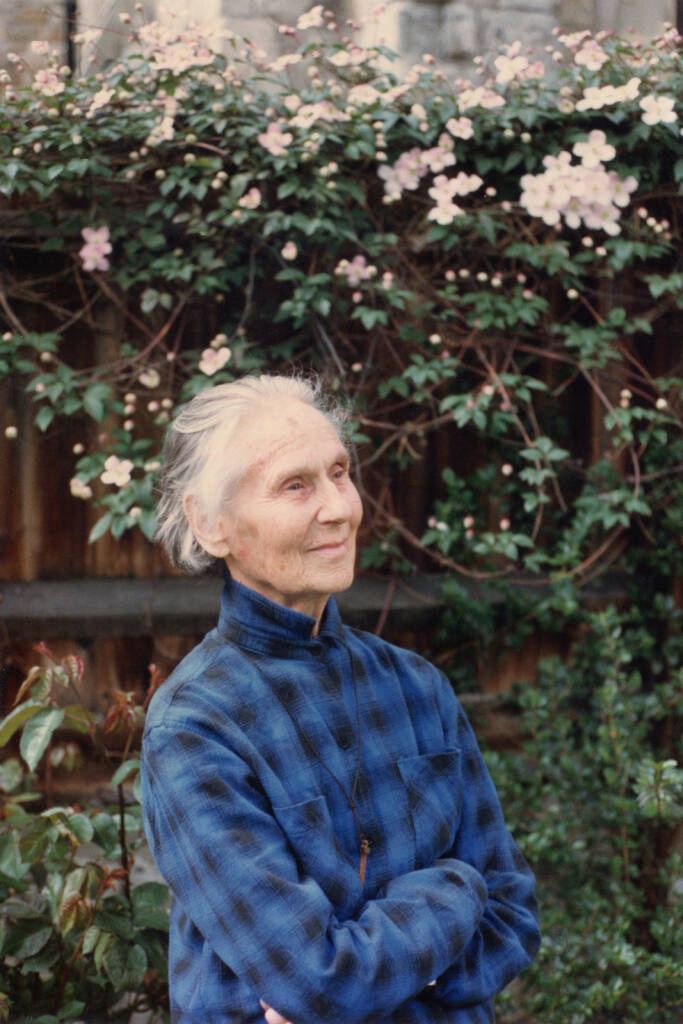
Mary Wykeham (1909–1996) was a British painter, printmaker and poet. Throughout her long artistic career she lived many lives; a young trainee nurse in London taking evening art classes at the Slade School of Art; an anti-fascist in Berlin helping Jewish artists flee the Nazi regime; a communist tailed through London by MI5; a Surrealist exhibiting alongside Agar, Dalí and Magritte; a nun with a higher devotional calling.
Throughout these journeys, her artwork remained a constant, and within that, her draw to nature. Her landscapes vary from bucolic watercolours of the Isle of Wight where she grew up, to abstract geometrical engravings of the Algerian desert.
In the 1930s, Wykeham studied etching at Atelier 17 in Paris under Stanley William Hayter, and met artists like Tanguy, Ernst, and Picasso. Hayter’s unique copper engraving process incorporated Surrealist techniques like automatic drawing, which highly influenced Wykeham’s surreal landscapes from this period. Her Hurricane and Wind Figures etchings make tangible forms of the invisible traces of air and wind.
From then, Wykeham became a frequent collaborator with The British Surrealist Group; taken by Surrealism’s ‘enthusiastic aim to change the world by altering consciousness and changing social and political issues’, as she described in her memoir. In 1936, she was among those who published the ‘Declaration on Spain’ countering Britain’s neutral stance against Franco during the Spanish Civil War.
Despite this activity, Wykeham remained, until recently, written out of the history of the Surrealist movement and art history altogether. Many Surrealists, including André Breton, did not believe that religion and spirituality could exist alongside surrealism, and this perhaps was a reason for Wykeham’s absence, together with her first convent who banned, and even burned, her artwork.
Though Wykeham was known for leaving her art career behind to become a nun in 1950, she studied many different religions and philosophies throughout her life which naturally appeared in her work, including principles of Taoism in The Secret of the Golden Flower. When Wykeham became a Catholic nun, she continued to explore religious themes, portraying the ‘divine chaos’ of hymns and Christian architecture, in works like Contemplatio and Windows. She stated that the Surrealist’s ‘anti-religious declarations were a catalyst’, allowing her to find ‘new roads in the arts and in living’ by combining Christianity and Surrealism.
Image of artist: Alison Smith
Image of work: Gift from Judith Wykeham, 2023. Wakefield Council Permanent Art Collection (The Hepworth Wakefield). © Judith Wykeham