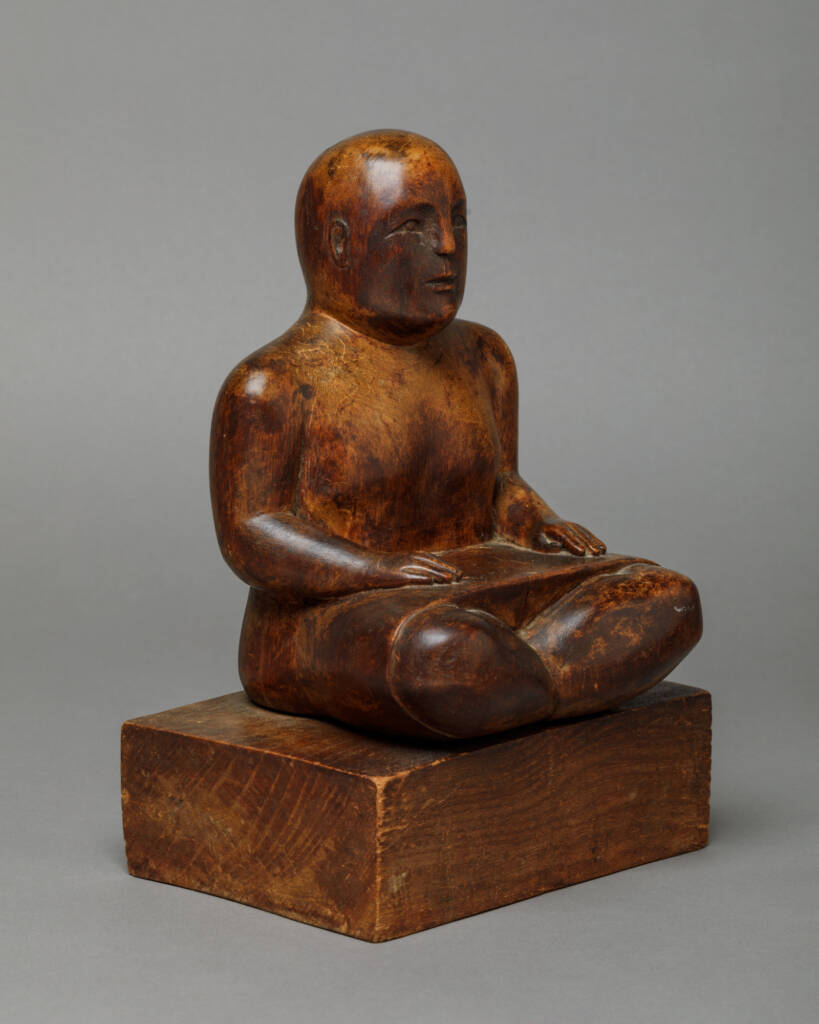
Ronald Moody
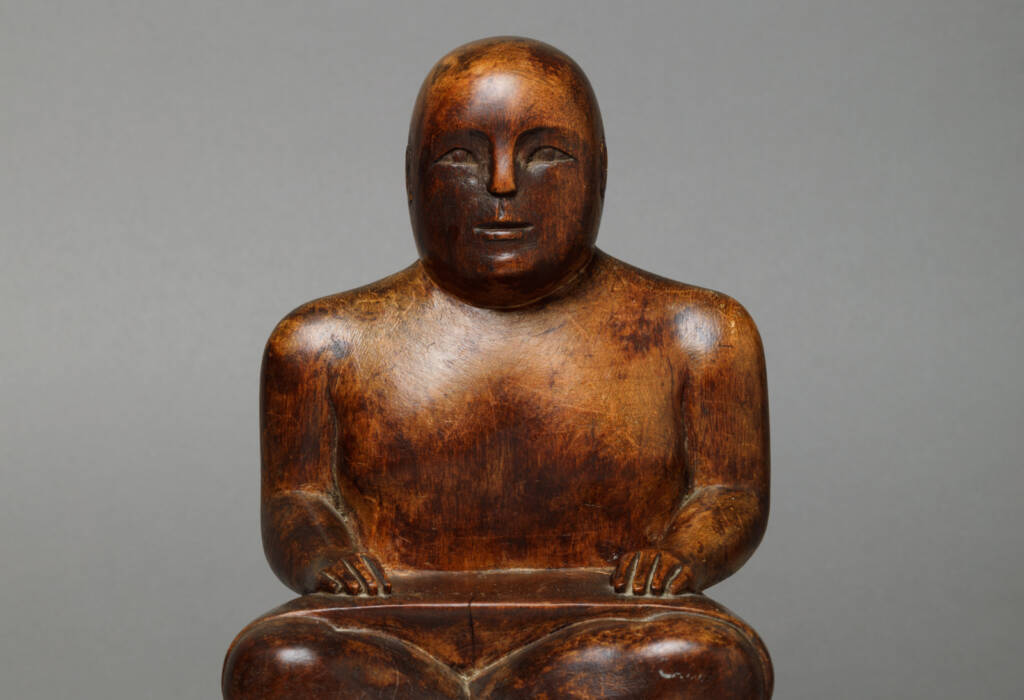
Seated Sarong Figure
1900-1984
Beech – tinted
27 x 18 x 14 cm
This sculpture belongs to an important group of Moody’s 1930s wood carvings, produced during the early phase of his sculptural career. It depicts a seated figure draped in a sarong, suggesting influences drawn from non-European cultural dress and forms. The work demonstrates Moody’s commitment to direct carving, a technique central to modernist sculpture in the interwar period. The figure is stylised rather than naturalistic, reflecting Moody’s interest in expressive form rather than anatomical precision. The carving emphasises the compactness and solidity of the seated body, a quality that appears in several of his early figurative sculptures.
This period also includes works such as Une Tête (1937/11), L’Homme (1937/8), and Annie (1938/4), which together show Moody developing a distinctive sculptural language based on simplified forms and psychological presence.
The wood used to carve Seated Sarong Figure came from the Estate of Annie van Beuningen-Eschauzir, who was the sister-in-law of the internationally known art collector George van Beuningen. Moody and Beuningen-Eschauzir met at the opening of his solo exhibition in Amsterdam at Kunztzaal van Lier, on 8th January 1938 and became immediate friends. .
Seated Sarong Figure was one of the twelve sculptures, shipped to the United States from Paris and London in 1938, for an exhibition arranged by Harmon Foundation in New York. They remained in the custody of the Foundation throughout the war, and for several years afterwards, despite many abortive attempts on Moody’s part to have them returned.
Matters came to a head in 1949 when, after three years spent fighting tuberculosis Moody was able to reschedule his postponed exhibition at the Galerie Apollinaire. During this time Moody’s friend Mary Seton was travelling from the US to Europe leaving Europe and managed to bring some of Moody’s small pieces with her. Her husband Donald Hessen, an attorney, aided in the negotiation Moody’s works being handed back to the artist.
In the late 1930s Moody moved among artists, writers, and critics—including Seton—within the modernist art scene in London and Paris. Seton was one of the first people to recognise Moody’s talent as a sculptor. In 1935 she bought his early sculpture Wohin (1934), which helped bring attention to his work.
She helped establish his reputation as an art critic and cultural figure, Seton promoted and wrote about Moody’s sculpture, helping introduce him to wider artistic circles and exhibitions.
They remained long-term friends, exchanging letters for many years and staying in contact about art, politics, and opportunities for his work.